New Vidyasagar Book Mart
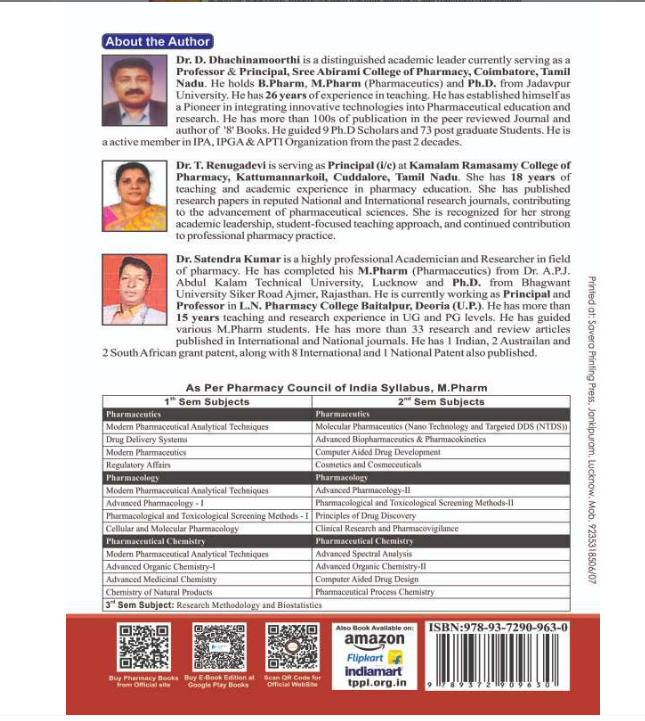
ADVANCED BIOPHARMACEUTICS & PHARMACOKINETICS (PHARMACEUTICS FIRST EDITION), Authors : Dr. D. Dhachinamoorthi, Dr. T. Renugadevi, Dr. Satendra Kumar, THAKUR PUBLICATIONS PVT LTD
ADVANCED BIOPHARMACEUTICS & PHARMACOKINETICS (PHARMACEUTICS FIRST EDITION), Authors : Dr. D. Dhachinamoorthi, Dr. T. Renugadevi, Dr. Satendra Kumar, THAKUR PUBLICATIONS PVT LTD
Couldn't load pickup availability
Syllabus
MPH 202T
Advanced Biopharmaceutics & Pharmacokinetics
Theory (60 Hours)
Unit-1 (12 hours)
Drug Absorption from the Gastrointestinal Tract: Gastrointestinal tract, Mechanism of drug absorption, Factors affecting drug absorption, pH–partition theory of drug absorption. Formulation and physicochemical factors: Dissolution rate, Dissolution process, Noyes–Whitney equation and drug dissolution, Factors affecting the dissolution rate. Gastrointestinal absorption: role of the dosage form: Solution (elixir, syrup and solution) as a dosage form, Suspension as a dosage form, Capsule as a dosage form, Tablet as a dosage form, Dissolution methods ,Formulation and processing factors, Correlation of in vivo data with in vitro dissolution data. Transport model: Permeability-Solubility Charge State and the pH Partition Hypothesis, Properties of the Gastrointestinal Tract (GIT), pH Microclimate Intracellular pH Environment, Tight-Junction Complex.
Unit-2 (12 hours)
Biopharmaceutic Considerations in Drug Product Design and In Vitro Drug Product Performance: Introduction, biopharmaceutic factors affecting drug bioavailability, rate-limiting steps in drug absorption, physicochemical nature of the drug formulation factors affecting drug product performance, in vitro: dissolution and drug release testing, Compendial methods of dissolution, alternative methods of dissolution testing, meeting dissolution requirements, problems of variable control in dissolution testing performance of drug products. In vitro–in vivo correlation, dissolution profile comparisons, drug product stability, considerations in the design of a drug product.
Unit-3 (12 hours)
Pharmacokinetics: Basic considerations, pharmacokinetic models, compartment modeling: one compartment model- IV bolus, IV infusion, extra-vascular. Multi compartment model: two compartment-model in brief, non-linear pharmacokinetics: cause of non-linearity, Michaelis–Menten equation, estimation of kmax and vmax. Drug interactions: introduction, the effect of protein binding interactions, the effect of tissue-binding interactions, cytochrome p450-based drug interactions, drug interactions linked to transporters.
Unit-4 (12 hours)
Drug Product Performance, In Vivo: Bioavailability and Bioequivalence: Drug product performance, purpose of bioavailability studies, relative and absolute availability. Methods for assessing bioavailability, bioequivalence studies, design and evaluation of bioequivalence studies, study designs, crossover study designs, evaluation of the data, bioequivalence example, study submission and drug review process. Biopharmaceutics classification system, methods. Permeability: In-vitro, in-situ and In-vivo methods. Generic biologics (biosimilar drug products), clinical significance of bioequivalence studies, special concerns in bioavailability and bioequivalence studies, generic substitution.
Unit-5 (12 hours)
Application of Pharmacokinetics: Modified-Release Drug Products, Targeted Drug Delivery Systems and Biotechnological Products. Introduction to Pharmacokinetics and pharmacodynamic, drug interactions. Pharmacokinetics and pharmacodynamics of biotechnology drugs. Introduction, Proteins and peptides, Monoclonal antibodies, Oligonucleotides, Vaccines (immunotherapy), Gene therapies.
Share