New Vidyasagar Book Mart
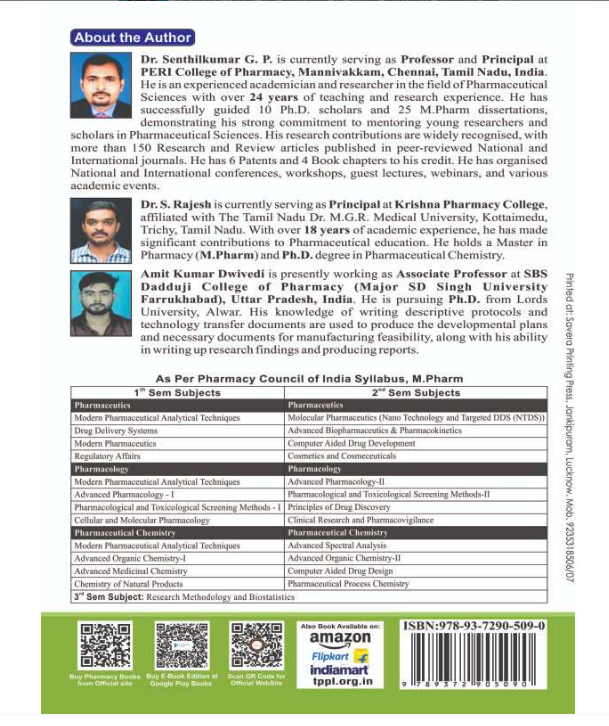
COMPUTER AIDED DRUG DESIGN (PHARMACEUTICAL CHEMISTRY) M.PHARM SECOND SEMESTER,Authors: Senthilkumar G.P. , Dr. S. Rajesh , Amit Kumar Dwivedi, THAKUR PUBLICATIONS PVT LTD
COMPUTER AIDED DRUG DESIGN (PHARMACEUTICAL CHEMISTRY) M.PHARM SECOND SEMESTER,Authors: Senthilkumar G.P. , Dr. S. Rajesh , Amit Kumar Dwivedi, THAKUR PUBLICATIONS PVT LTD
Couldn't load pickup availability
Syllabus
MPC 203T
Computer Aided Drug Design
Theory (60 Hours)
Unit-1 (12 hours)
Introduction to Computer Aided Drug Design (CADD): History, different techniques and applications. Quantitative Structure Activity Relationships: Basics History and development of QSAR: Physicochemical parameters and methods to calculate physicochemical parameters: Hammett equation and electronic parameters (sigma), lipophilicity effects and parameters (log P, pi-substituent constant), steric effects (Taft steric and MR parameters) Experimental and theoretical approaches for the determination of these physicochemical parameters.
Unit-2 (12 hours)
Quantitative Structure Activity Relationships: Applications Hansch analysis, Free Wilson analysis and relationship between them, Advantages and disadvantages; Deriving 2D-QSAR equations. 3D-QSAR approaches and contour map analysis. Statistical methods used in QSAR analysis and importance of statistical parameters.
Unit-3 (12 hours)
Molecular Modeling and Docking:
a) Molecular and Quantum Mechanics in drug design.
b) Energy Minimization Methods: Comparison between global minimum conformation and bioactive conformation.
c) Molecular Docking and Drug Receptor Interactions: Rigid docking, flexible docking and extra-precision docking. Agents acting on enzymes such as DHFR, HMG-CoA reductase and HIV protease, choline esterase (AChE & BChE).
Unit-4 (12 hours)
Molecular Properties and Drug Design:
a) Prediction and analysis of ADMET properties of new molecules and its importance in drug design.
b) De novo Drug Design: Receptor/enzyme-interaction and its analysis, Receptor/enzyme cavity size prediction, predicting the functional components of cavities, Fragment based drug design.
c) Homology modeling and generation of 3D-structure of protein.
Unit-5 (12 hours)
Pharmacophore Mapping and Virtual Screening: Concept of pharmacophore, pharmacophore mapping, identification of Pharmacophore features and Pharmacophore modeling; Conformational search used in pharmacophore mapping.
In Silico Drug Design and Virtual Screening Techniques: Similarity based methods and Pharmacophore based screening, structure based In-silico virtual screening protocols.
Share