New Vidyasagar Book Mart
HUMAN ANATOMY AND PHYSIOLOGY-II B.PHARM 2ND SEMESTER , Authors: Dr. Babuji Seevalen & Dr. Pragnesh Patani ,THAKUR PUBLICATIONS PVT LTD
HUMAN ANATOMY AND PHYSIOLOGY-II B.PHARM 2ND SEMESTER , Authors: Dr. Babuji Seevalen & Dr. Pragnesh Patani ,THAKUR PUBLICATIONS PVT LTD
Couldn't load pickup availability
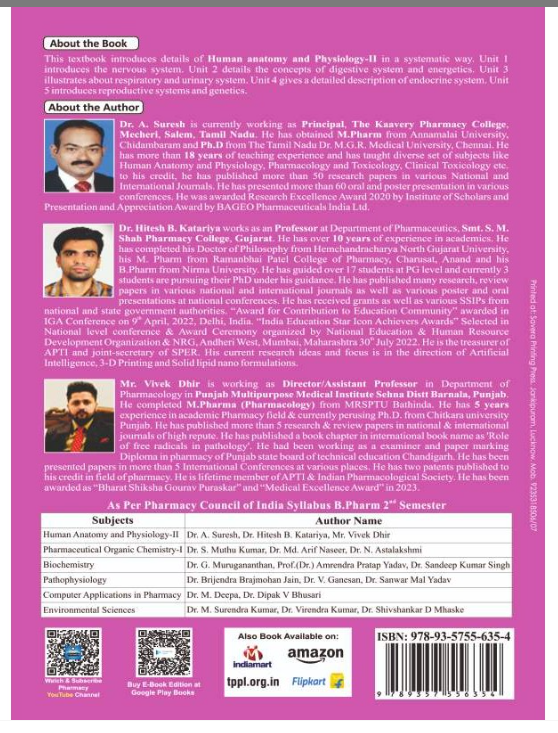
The PCI B.Pharm Second semester Human Anatomy and Physiology-II book is a comprehensive guide to the fundamental principles of anatomy and physiology. It covers a wide range of topics including cell structure, tissues, organs, and systems of the human body. It also includes clinical correlations that help students understand the relevance of anatomy and physiology to clinical practice. With clear illustrations and concise explanations, this book is an essential resource for students studying pharmacy and related health sciences.
| As per approved syllabus of Pharmacy Council of India |
| Written by Experienced Authors |
| Fast & All India Delivery |
Syllabus
Code: BP201T
HUMAN ANATOMY AND PHYSIOLOGY-II
|
Unit
|
Contents
|
Hours
|
|
I
|
· Nervous System
Organisation of nervous system, neuron, neuroglia, classification and properties of nerve fibre, electrophysiology, action potential, nerve impulse, receptors, synapse, neurotransmitters.
Central Nervous System: Meninges, ventricles of brain and Cerebrospinal fluid. structure and functions of brain (cerebrum, brain stem, cerebellum), spinal cord (gross structure, functions of afferent and efferent nerve tracts, reflex activity).
|
10
|
|
II
|
· Digestive System
Anatomy of GI Tract with special reference to anatomy and functions of stomach, (Acid production in the stomach, regulation of acid production through parasympathetic nervous system, pepsin role in protein digestion) small intestine and large intestine, anatomy and functions of salivary glands, pancreas and liver, movements of GIT, digestion and absorption of nutrients and disorders of GIT.
· Energetics
Formation and role of ATP, Creatinine Phosphate and BMR.
|
6
|
|
III
|
· Respiratory System
Anatomy of respiratory system with special reference to anatomy of lungs, mechanism of respiration, regulation of respiration Lung Volumes and capacities transport of respiratory gases, artificial respiration, and resuscitation methods.
· Urinary System
Anatomy of urinary tract with special reference to anatomy of kidney and nephrons, functions of kidney and urinary tract, physiology of urine formation, micturition reflex and role of kidneys in acid base balance, role of RAS in kidney and disorders of kidney.
|
10
|
|
IV
|
· Endocrine System
Classification of hormones, mechanism of hormone action, structure and functions of pituitary gland, thyroid gland, parathyroid gland, adrenal gland, pancreas, pineal gland, thymus and their disorders.
|
10
|
|
V
|
· Reproductive System
Anatomy of male and female reproductive system, Functions of male and female reproductive system, sex hormones, physiology of menstruation, fertilisation, spermatogenesis, oogenesis, pregnancy and parturition.
· Introduction to Genetics
Chromosomes, genes and DNA, protein synthesis, genetic pattern of inheritance.
|
9
|
|
|
Practical
|
|
|
1) To study the integumentary and special senses using specimen, models, etc.,
2) To study the nervous system using specimen, models, etc.
3) To study the endocrine system using specimen, models, etc.
4) To demonstrate the general neurological examination.
5) To demonstrate the function of olfactory nerve.
6) To examine the different types of taste.
7) To demonstrate the visual acuity.
8) To demonstrate the reflex activity.
9) Recording of body temperature.
10) To demonstrate positive and negative feedback mechanism.
11) Determination of tidal volume and vital capacity.
12) Study of digestive, respiratory, cardiovascular systems, urinary and reproductive systems with the help of models, charts and specimens.
13) Recording of basal mass index.
14) Study of family planning devices and pregnancy diagnosis test.
15) Demonstration of total blood count by cell analyser.
16) Permanent slides of vital organs and gonads.
|
4 Hours/ week
|
|
Contents
|
Unit-I
Chapter 1: Nervous System
|
||
|
1.1.
|
Organisation of Nervous System
|
15
|
|
1.2.
|
Functions of Nervous System
|
16
|
|
1.3.
|
Neurons
|
17
|
|
1.3.1.
|
Structure of Neurons
|
17
|
|
1.3.2.
|
Types of Neurons
|
19
|
|
1.4.
|
Neuroglia/Neuroglial Cells
|
20
|
|
1.4.1.
|
Structure of Neuroglial Cells
|
20
|
|
1.4.2.
|
Functions of Neuroglial Cells
|
21
|
|
1.5.
|
Nerve Fibre
|
21
|
|
1.6.
|
Electrophysiology of Neurons
|
23
|
|
1.6.1.
|
Ion Channels
|
23
|
|
1.6.2.
|
Resting Membrane Potential (RMP)
|
24
|
|
1.6.3.
|
Nerve Impulse (Electrical Signals in Neuron)
|
24
|
|
1.6.4.
|
Graded Potential
|
24
|
|
1.6.5.
|
Action Potential
|
25
|
|
1.7.
|
Receptors
|
28
|
|
1.7.1.
|
Classification of Receptors
|
28
|
|
1.7.2.
|
Physiology of Receptors
|
30
|
|
1.8.
|
Synapses
|
30
|
|
1.8.1.
|
Types of Synapses
|
30
|
|
1.8.2.
|
Synaptic Transmission
|
32
|
|
1.9.
|
Neurotransmitters
|
33
|
|
1.9.1.
|
Classification of Neurotransmitter
|
34
|
|
1.9.2.
|
Transmission of Impulses (Neurotransmission)
|
34
|
|
1.10.
|
Exercise
|
35
|
|
Chapter 2: Central Nervous System
|
||
|
2.1.
|
Brain
|
37
|
|
2.1.1.
|
Meninges of Brain
|
38
|
|
2.1.2.
|
Ventricles of Brain
|
38
|
|
2.1.3.
|
Cerebrospinal Fluid (CSF)
|
39
|
|
2.1.4.
|
Structure of Brain
|
41
|
|
2.1.5.
|
Functions of Brain
|
41
|
|
2.2.
|
Cerebrum
|
42
|
|
2.2.1.
|
Cerebral Cortex
|
43
|
|
2.2.2.
|
Cerebral White Matter
|
43
|
|
2.2.3.
|
Lobes of Cerebrum
|
43
|
|
2.2.4.
|
Basal Ganglia
|
45
|
|
2.2.5.
|
Limbic System
|
45
|
|
2.3.
|
Brain Stem
|
49
|
|
2.3.1.
|
Medulla Oblongata
|
49
|
|
2.3.2.
|
Pons
|
50
|
|
2.3.3.
|
Midbrain
|
51
|
|
2.4.
|
Cerebellum
|
51
|
|
2.5.
|
Diencephalon
|
53
|
|
2.5.1.
|
Thalamus
|
53
|
|
2.5.2.
|
Hypothalamus
|
55
|
|
2.5.3.
|
Epithalamus
|
56
|
|
2.5.4.
|
Subthalamus
|
57
|
|
2.6.
|
Blood Brain Barrier (BBB)
|
57
|
|
2.7.
|
Spinal Cord
|
58
|
|
2.7.1.
|
Gross Structure of Spinal Cord
|
59
|
|
2.7.2.
|
Functions of Spinal Cord
|
61
|
|
2.7.3.
|
Spinal Tracts
|
61
|
|
2.8.
|
Reflex Activity
|
63
|
|
2.8.1.
|
Reflex Arc
|
63
|
|
2.8.2.
|
Types of Reflexes
|
65
|
|
2.9.
|
Exercise
|
65
|
|
Unit-II
Chapter 3: Digestive System
|
||
|
3.1.
|
Gastrointestinal Tract
|
67
|
|
3.2.
|
Oral Cavity (Mouth)
|
68
|
|
3.2.1.
|
Teeth
|
69
|
|
3.2.2.
|
Tongue
|
70
|
|
3.2.3.
|
Functions of the Oral Cavity
|
71
|
|
3.3.
|
Pharynx
|
71
|
|
3.3.1.
|
Anatomy of Pharynx
|
72
|
|
3.3.2.
|
Functions of Pharynx
|
72
|
|
3.4.
|
Oesophagus
|
73
|
|
3.4.1.
|
Anatomy of Oesophagus
|
74
|
|
3.4.2.
|
Functions of Oesophagus
|
74
|
|
3.5.
|
Stomach
|
74
|
|
3.5.1.
|
Anatomy of Stomach
|
74
|
|
3.5.2.
|
Acid Production in the Stomach
|
75
|
|
3.5.3.
|
Regulation of Acid Production through Parasympathetic Nervous System/ Phases of Digestion
|
76
|
|
3.5.4.
|
Pepsin Role in Protein Digestion
|
79
|
|
3.5.5.
|
Functions of Stomach
|
80
|
|
3.6.
|
Small Intestine
|
80
|
|
3.6.1.
|
Anatomy of Small Intestine
|
81
|
|
3.6.2.
|
Functions of Small Intestine
|
81
|
|
3.7.
|
Large Intestine
|
82
|
|
3.7.1.
|
Anatomy of Large Intestine
|
82
|
|
3.7.2.
|
Functions of Large Intestine
|
83
|
|
3.8.
|
Salivary Glands
|
84
|
|
3.8.1.
|
Anatomy of Salivary Glands
|
84
|
|
3.8.2.
|
Functions of Salivary Glands
|
85
|
|
3.9.
|
Pancreas
|
86
|
|
3.9.1.
|
Anatomy of Pancreas
|
86
|
|
3.9.2.
|
Functions of Pancreas
|
87
|
|
3.10.
|
Liver
|
87
|
|
3.10.1.
|
Anatomy of Liver
|
87
|
|
3.10.2.
|
Functions of Liver
|
88
|
|
3.11.
|
Gall Bladder
|
89
|
|
3.11.1.
|
Anatomy of Gall Bladder
|
89
|
|
3.11.2.
|
Functions of Gall Bladder
|
90
|
|
3.12.
|
Movements of GIT
|
90
|
|
3.12.1.
|
Mastication
|
91
|
|
3.12.2.
|
Swallowing or Deglutition
|
92
|
|
3.12.3.
|
Movement of Stomach
|
93
|
|
3.12.4.
|
Movement of Small Intestine
|
94
|
|
3.12.5.
|
Movement of Large Intestine
|
94
|
|
3.13.
|
Digestion and Absorption of Nutrients
|
95
|
|
3.14.
|
Disorders of GIT
|
100
|
|
3.14.1.
|
Mouth Ulcers
|
100
|
|
3.14.2.
|
Mumps
|
101
|
|
3.14.3.
|
Pharyngitis
|
101
|
|
3.14.4.
|
Tonsillitis
|
101
|
|
3.14.5.
|
Gastroesophageal Reflux Disease (GERD)
|
102
|
|
3.14.6.
|
Gastric Ulcer (Peptic Ulcer)
|
102
|
|
3.14.7.
|
Appendicitis
|
103
|
|
3.14.8.
|
Crohn’s Disease
|
103
|
|
3.14.9.
|
Gall Stones (Cholelithiasis)
|
103
|
|
3.15.
|
Exercise
|
104
|
|
Chapter 4: Energetics
|
||
|
4.1.
|
Basics of Energetics
|
106
|
|
4.1.1.
|
Energy Transfer
|
107
|
|
4.1.2.
|
Metabolism
|
107
|
|
4.2.
|
Formation of ATP
|
108
|
|
4.2.1.
|
From Carbohydrate Metabolism
|
109
|
|
4.2.2.
|
From Lipid Metabolism
|
114
|
|
4.2.3.
|
From Protein Metabolism - Urea Cycle or Kreb-Henseleit Cycle
|
116
|
|
4.3.
|
Role of ATP
|
119
|
|
4.4.
|
Formation and Role of Creatinine Phosphate
|
119
|
|
4.5.
|
Basal Metabolic Rate (BMR)
|
121
|
|
4.5.1.
|
Factors Affecting BMR
|
122
|
|
4.5.2.
|
BMR Unit
|
122
|
|
4.6.
|
Exercise
|
123
|
|
Unit-III
Chapter 5: Respiratory System
|
||
|
5.1.
|
Anatomy of Respiratory System
|
124
|
|
5.2.
|
Nose
|
125
|
|
5.2.1.
|
Anatomy of Nose
|
125
|
|
5.2.2.
|
Functions of Nose
|
127
|
|
5.3.
|
Pharynx
|
127
|
|
5.3.1.
|
Anatomy of Pharynx
|
128
|
|
5.3.2.
|
Functions of Pharynx
|
128
|
|
5.4.
|
Larynx
|
128
|
|
5.4.1.
|
Anatomy of Larynx
|
129
|
|
5.4.2.
|
Functions of Larynx
|
130
|
|
5.5.
|
Trachea
|
131
|
|
5.5.1.
|
Anatomy of Trachea
|
131
|
|
5.5.2.
|
Functions of Trachea
|
132
|
|
5.6.
|
Bronchi and Bronchioles
|
132
|
|
5.6.1.
|
Anatomy of Bronchi
|
132
|
|
5.6.2.
|
Functions of Bronchi
|
133
|
|
5.7.
|
Lungs
|
133
|
|
5.7.1.
|
Anatomy of Lungs
|
133
|
|
5.7.2.
|
Functions of Lungs
|
135
|
|
5.8.
|
Alveoli
|
135
|
|
5.8.1.
|
Anatomy of Alveoli
|
135
|
|
5.8.2.
|
Functions of Alveoli
|
136
|
|
5.9.
|
Mechanism of Respiration
|
136
|
|
5.10.
|
Regulation of Respiration
|
138
|
|
5.10.1.
|
Nervous Control
|
138
|
|
5.10.2.
|
Chemical Control
|
139
|
|
5.11.
|
Lung Volumes and Capacities
|
139
|
|
5.12.
|
Transport of Respiratory Gases
|
141
|
|
5.13.
|
Resuscitation Methods (Artificial Respiration)
|
143
|
|
5.14.
|
Exercise
|
150
|
|
Chapter 6: Urinary System
|
||
|
6.1.
|
Anatomy of Urinary Tract
|
152
|
|
6.2.
|
Kidneys
|
153
|
|
6.2.1.
|
Anatomy of Kidney
|
153
|
|
6.2.2.
|
Functions of Kidney
|
155
|
|
6.3.
|
Nephrons
|
155
|
|
6.3.1.
|
Anatomy of Nephron
|
156
|
|
6.3.2.
|
Functions of Nephrons
|
158
|
|
6.4.
|
Ureters
|
159
|
|
6.4.1.
|
Anatomy of Ureters
|
159
|
|
6.4.2.
|
Functions of Ureters
|
160
|
|
6.5.
|
Urinary Bladder
|
160
|
|
6.5.1.
|
Anatomy of Urinary Bladder
|
161
|
|
6.5.2.
|
Functions of Urinary Bladder
|
161
|
|
6.6.
|
Urethra
|
162
|
|
6.6.1.
|
Anatomy of Urethra
|
162
|
|
6.6.2.
|
Functions of Urethra
|
163
|
|
6.7.
|
Physiology of Urine Formation
|
163
|
|
6.7.1.
|
Ultrafiltration/Glomerular Filtration
|
164
|
|
6.7.2.
|
Tubular Reabsorption
|
167
|
|
6.7.3.
|
Tubular Secretion
|
171
|
|
6.8.
|
Micturition Reflex
|
171
|
|
6.9.
|
Role of Kidneys in Acid-Base Balance
|
173
|
|
6.9.1.
|
Types of Acid-Base Balance
|
173
|
|
6.9.2.
|
Effects of Acid-Base Balance in Renal Physiology
|
174
|
|
6.9.3.
|
Factors Affecting Acid-Base Balance Processes
|
174
|
|
6.9.4.
|
Regulation of Acid-Base Balance
|
175
|
|
6.9.5.
|
Imbalance in Acid-Base Balance
|
175
|
|
6.10.
|
Role of Renin Angiotensin System (RAS) in Kidneys
|
175
|
|
6.11.
|
Disorders of Kidney
|
177
|
|
6.11.1.
|
Renal Calculi (Kidney Stones)
|
177
|
|
6.11.2.
|
Urinary Tract Infections (UTIs)
|
177
|
|
6.11.3.
|
Renal Failure
|
178
|
|
6.11.4.
|
Urethritis
|
178
|
|
6.11.5.
|
Urinary Bladder Cancer
|
179
|
|
6.12.
|
Exercise
|
179
|
|
Unit-IV
Chapter 7: Endocrine System
|
||
|
7.1.
|
Hormones
|
181
|
|
7.1.1.
|
Classification of Hormones
|
181
|
|
7.1.2.
|
Mechanism of Hormone Action
|
182
|
|
7.2.
|
Endocrine Glands and Their Secretions
|
185
|
|
7.3.
|
Hypothalamus
|
186
|
|
7.3.1.
|
Structure of Hypothalamus
|
186
|
|
7.3.2.
|
Hormones of Hypothalamus
|
186
|
|
7.3.3.
|
Functions of Hypothalmus
|
188
|
|
7.4.
|
Pituitary Gland
|
188
|
|
7.4.1.
|
Structure of Pituitary Gland
|
188
|
|
7.4.2.
|
Hormones of Pituitary Gland
|
189
|
|
7.4.2.1.
|
Growth Hormone (GH)
|
190
|
|
7.4.2.2.
|
Thyroid Stimulating Hormone (TSH)
|
190
|
|
7.4.2.3.
|
Adrenocorticotropic Hormone (ATCH)
|
191
|
|
7.4.2.4.
|
Prolactin (PRL)
|
191
|
|
7.4.2.5.
|
Gonadotropins (FSH and LH)
|
192
|
|
7.4.2.6.
|
Melanocyte Stimulating Hormone (MSH)
|
192
|
|
7.4.2.7.
|
Antidiuretic Hormone (ADH)
|
193
|
|
7.4.2.8.
|
Oxytocin
|
193
|
|
7.4.3.
|
Functions of Pituitary Gland
|
193
|
|
7.5.
|
Thyroid Gland
|
194
|
|
7.5.1.
|
Structure of Thyroid Gland
|
194
|
|
7.5.2.
|
Hormones of Thyroid Gland
|
195
|
|
7.5.2.1.
|
Thyroxine
|
195
|
|
7.5.2.2.
|
Thyrocalcitonin (TCT)
|
195
|
|
7.5.3.
|
Functions of Thyroid Gland
|
196
|
|
7.6.
|
Parathyroid Gland
|
196
|
|
7.6.1.
|
Structure of Parathyroid Gland
|
196
|
|
7.6.2.
|
Hormone of Parathyroid Gland
|
197
|
|
7.6.3.
|
Functions of Parathyroid Gland
|
198
|
|
7.7.
|
Adrenal Gland
|
198
|
|
7.7.1.
|
Structure of Adrenal Gland
|
198
|
|
7.7.2.
|
Hormones of Adrenal Gland
|
199
|
|
7.7.3.
|
Functions of Adrenal Gland
|
201
|
|
7.8.
|
Pancreas
|
201
|
|
7.8.1.
|
Structure of Pancreas
|
202
|
|
7.8.2.
|
Hormones of Pancreas
|
202
|
|
7.8.3.
|
Functions of Pancreas
|
204
|
|
7.9.
|
Pineal Gland
|
204
|
|
7.9.1.
|
Structure of Pineal Gland
|
204
|
|
7.9.2.
|
Hormone of Pineal Gland
|
205
|
|
7.9.3.
|
Functions of Pineal Gland
|
205
|
|
7.10.
|
Thymus
|
205
|
|
7.10.1.
|
Introduction
|
205
|
|
7.10.2.
|
Structure of Thymus
|
206
|
|
7.10.3.
|
Hormone of Thymus
|
206
|
|
7.10.4.
|
Functions of Thymus
|
206
|
|
7.11.
|
Disorders of Endocrine Glands
|
207
|
|
7.11.1.
|
Hyposecretion of Endocrine Glands
|
207
|
|
7.11.2.
|
Hypersecretion of Endocrine Glands
|
209
|
|
7.12.
|
Exercise
|
211
|
|
Unit-V
Chapter 8: Reproductive System
|
||
|
8.1.
|
Anatomy and Functions of Male Reproductive System
|
212
|
|
8.1.1.
|
Scrotum and Testes
|
213
|
|
8.1.2.
|
Accessory Ducts
|
214
|
|
8.1.3.
|
Glands
|
215
|
|
8.1.4.
|
External Genitalia (Penis)
|
216
|
|
8.2.
|
Anatomy and Functions of Female Reproductive System
|
217
|
|
8.2.1.
|
External Genitalia (Vulva)
|
218
|
|
8.2.2.
|
Internal Genitalia
|
218
|
|
8.2.2.1.
|
Vagina
|
218
|
|
8.2.2.2.
|
Uterus
|
219
|
|
8.2.2.3.
|
Uterine/Fallopian Tubes (Oviduct)
|
220
|
|
8.2.2.4.
|
Ovaries
|
221
|
|
8.2.2.5.
|
Breasts (Mammary Glands)
|
222
|
|
8.3.
|
Sex Hormones
|
222
|
|
8.4.
|
Physiology of Menstruation
|
225
|
|
8.5.
|
Gametogenesis
|
228
|
|
8.5.1.
|
Spermatogenesis
|
228
|
|
8.5.2.
|
Oogenesis
|
230
|
|
8.6.
|
Reproduction
|
231
|
|
8.6.1.
|
Fertilisation
|
232
|
|
8.6.2.
|
Cleavage of the Zygote
|
233
|
|
8.6.3.
|
Blastocyst Formation
|
234
|
|
8.6.4.
|
Implantation
|
235
|
|
8.7.
|
Pregnancy
|
236
|
|
8.7.1.
|
Sign and Symptoms
|
236
|
|
8.7.2.
|
Trimester (Stages)
|
237
|
|
8.8.
|
Parturition/Childbirth
|
238
|
|
8.9.
|
Exercise
|
240
|
|
Chapter 9: Genetics
|
||
|
9.1.
|
Chromosomes
|
242
|
|
9.1.1.
|
Structural Organisation
|
242
|
|
9.1.2.
|
Functions of Chromosomes
|
243
|
|
9.2.
|
Genes
|
244
|
|
9.3.
|
DNA (Deoxyribonucleic Acid)
|
245
|
|
9.3.1.
|
Components of DNA
|
245
|
|
9.3.2.
|
Watson-Crick Model for DNA/ DNA Double Helix
|
246
|
|
9.3.3.
|
Functions of DNA
|
247
|
|
9.4.
|
RNA (Ribonucleic Acid)
|
248
|
|
9.4.1.
|
Types of RNA
|
248
|
|
9.4.2.
|
Functions of RNA
|
248
|
|
9.5.
|
Protein Synthesis
|
249
|
|
9.6.
|
Genetic Pattern of Inheritance
|
256
|
|
9.6.1.
|
Pedigree Analysis
|
257
|
|
9.6.2.
|
Mendelian Inheritance Patterns
|
257
|
|
9.6.3.
|
Non-Mendelian Inheritance Patterns
|
261
|
|
9.7.
|
Exercise
|
263
|
Practical
|
Practical-1: Study the integumentary and special senses using specimen, models, etc.
|
264
|
|
Practical-2: Study the nervous system using specimen, models, etc.
|
271
|
|
Practical-3: Study the endocrine system using specimen, models, etc.
|
275
|
|
Practical-4: Demonstration of general neurological examination.
|
277
|
|
Practical-5: Demonstration of olfactory nerve.
|
278
|
|
Practical-6: Examination of different types of taste.
|
279
|
|
Practical-7: Demonstration of visual acuity.
|
280
|
|
Practical-8: Demonstration of reflex activity.
|
282
|
|
Practical-9: Recording of body temperature.
|
283
|
|
Practical-10: Demonstration of positive and negative feedback mechanism.
|
285
|
|
Practical-11: Determination of tidal volume and vital capacity.
|
286
|
|
Practical-12: Study of digestive, respiratory, cardiovascular, urinary and reproductive systems with the help of models, charts and specimens.
|
288
|
|
Practical-13: Recording of basal mass index.
|
302
|
|
Practical-14: Family planning devices and pregnancy diagnosis tests.
|
303
|
|
Practical-15: Demonstration of total blood count by cell analyser.
|
305
|
|
Practical-16: Permanent slides of vital organs and gonads.
|
306
|
Share